Nominations for best director are often the same as those for best film, for obvious reasons. The same is not necessarily true for the winner though, as the last ten years can confirm...
2005 - Ang Lee, Brokeback Mountain ($14M)
2004 - Clint Eastwood, Million Dollar Baby ($30M)
2003 - Peter Jackson, The Lord of the Rings: The Return of the King ($94M)
2002 - Roman Polanski, The Pianist ($35M)
2001 - Ron Howard, A Beautiful Mind ($60M)
2000 - Steven Soderbergh, Traffic ($48M)
1999 - Sam Mendes, American Beauty ($15M)
1998 - Steven Spielberg, Saving Private Ryan ($70M)
1997 - James Cameron, Titanic ($200M)
1996 - Anthony Minghella, The English Patient ($27M)
Four out of the ten winners here did not also win for best picture, so obviously even though the director 'makes' the movie, the criteria used to decide the two categories differ. How about the budgets involved? Best pictures cost on average $65M, while best directors costs... $59M. It's a little less, but hardly, and a lot more than the average for best actor/actress. As I have repeated ad nauseum, this is basically the average for a studio film (NB: The Pianist and Traffic were 'independently' produced). None of these movies, however, cost less than the magic $10M, and there must be a reason, because coincidences, freak chances and short-term blips on long-term trends never occur, and Ang Lee would not have won if Brokeback Mountain had only cost $9M, do you here!
Maybe good/experienced/popular/whatever directors don't work on cheap movies. Or maybe it actually costs quite a lot of money for the acting, art and production design, lighting, cinematography and editing it takes to make a movie look well directed.
This is not to say that movies made for less than $10M cannot be brilliantly directed (I saw Peter Jackson's Braindead - $3M - on the weekend and it has fantastic direction, but I'm pretty sure he didn't crack an Oscar for it back in 1992) it is simply that what the weirdos in the academy look for in best director nominated films, whatever that might be, is not found in cheap movies.
So how do the 2006 nominees stack up...
Alejandro González Iñárritu, Babel ($25M)
Martin Scorsese, The Departed ($90M)
Clint Eastwood, Letters from Iwo Jima ($15M)
Steven Frears, The Queen ($15M)
Paul Greengrass, United 93 ($15M)
Well for one, it seems that for this category, 15 is the magic number. To back up my thoroughly research argument (no best directors for less than $10M), poor Little Miss Sunshine ($8M and nominated for best picture) gets bumped by the $15M United 93. Closest to the average is The Departed, so maybe it's finally Marty's year. Or maybe I don't know what the hell I'm talking about. Something to consider until next time.
Tuesday, February 13, 2007


Saturday, February 03, 2007
How much for your consideration? Best Actress
The best actress in a leading role requiring prosthetics, weight gain, playing a real person, ugliness or pretending to be a man goes to...
I suspect that the best actress award generally goes to movies that have below average budgets. Why? Women simply do not get good roles in big budget movies. Fact. Or is it? As I've done for the last few posts, let's have a look at the last ten years of Oscars and see what budgetary trends we can tease out.
2005 - Reese Witherspoon, Walk the Line ($28M)
2004 - Hilary Swank, Million Dollar Baby ($30M)
2003 - Charlize Theron, Monster ($8M)
2002 - Nicole Kidman, The Hours ($25M)
2001 - Halle Berry, Monster's Ball ($4M)
2000 - Julia Roberts, Erin Brockovich ($51M)
1999 - Hilary Swank, Boys don't Cry ($2M)
1998 - Gwyneth Paltrow, Shakespeare in Love ($25M)
1997 - Helen Hunt, As Good as it Gets ($50M)
1996 - Frances McDormand, Fargo ($7M)
First of all, four of these movies were made for under the magic $10M mark, and exactly zero were made for more than $100M. Not only that, but exactly zero were made for more than the average cost of a studio movie (about $65M). The average budget was a measly $23M, which Julia Roberts can make herself for a single film. The reason (not why Julia Roberts can make $23M for a single movie, that defies explanation, but why best actress movies are generally so cheap)? Well, for one, four of the movies (Monster, Monster's Ball, Boys don't Cry and Erin Brockovich) had no production input by one of the major studios, and films made by non-major studios by default have lower budgets. For two, see the first paragraph of this post: take this year for example; are they really going to give Audrey Tatou (The Da Vinci Code) an Oscar for being stupid, or Keira Knightly (Pirates of the Caribbean) one for being annoying, or Kate Bosworth (Superman Returns) one for not being as good as Margo Kidder.
And the nominees for 2006 are...
Penélope Cruz, Volver (unknown, say $5M)
Judie Dench, Notes on a Scandal (unknown, say $10M)
Helen Mirren, The Queen ($15M)
Meryl Streep, The Devil Wears Prada ($35M)
Kate Winslet, Little Children ($14M)
Fits the trend nicely, maybe even a little cheaper this year - which makes sense, considering there are no movies with Julia Roberts or Jack Nicholson in to bump up the average. Based on budgetary considerations alone, anyone could win. The first three weren't produced by one of the big six, but that is no help, as explained above, so I'm going to have to throw in the towel. Having said that, surely Judie Dench and Meryl Streep were only nominated because the nominating committee (or however the hell they go about nominations) are just plain lazy, Helen Mirren because she is going to win, Kate Winslet so they can shaft her again and Penélope Cruz as the token 'foreigner', or to piss off Tom Cruise (see also, the first line of this post, i.e. Helen Mirren plays a real person).
I suspect that the best actress award generally goes to movies that have below average budgets. Why? Women simply do not get good roles in big budget movies. Fact. Or is it? As I've done for the last few posts, let's have a look at the last ten years of Oscars and see what budgetary trends we can tease out.
2005 - Reese Witherspoon, Walk the Line ($28M)
2004 - Hilary Swank, Million Dollar Baby ($30M)
2003 - Charlize Theron, Monster ($8M)
2002 - Nicole Kidman, The Hours ($25M)
2001 - Halle Berry, Monster's Ball ($4M)
2000 - Julia Roberts, Erin Brockovich ($51M)
1999 - Hilary Swank, Boys don't Cry ($2M)
1998 - Gwyneth Paltrow, Shakespeare in Love ($25M)
1997 - Helen Hunt, As Good as it Gets ($50M)
1996 - Frances McDormand, Fargo ($7M)
First of all, four of these movies were made for under the magic $10M mark, and exactly zero were made for more than $100M. Not only that, but exactly zero were made for more than the average cost of a studio movie (about $65M). The average budget was a measly $23M, which Julia Roberts can make herself for a single film. The reason (not why Julia Roberts can make $23M for a single movie, that defies explanation, but why best actress movies are generally so cheap)? Well, for one, four of the movies (Monster, Monster's Ball, Boys don't Cry and Erin Brockovich) had no production input by one of the major studios, and films made by non-major studios by default have lower budgets. For two, see the first paragraph of this post: take this year for example; are they really going to give Audrey Tatou (The Da Vinci Code) an Oscar for being stupid, or Keira Knightly (Pirates of the Caribbean) one for being annoying, or Kate Bosworth (Superman Returns) one for not being as good as Margo Kidder.
And the nominees for 2006 are...
Penélope Cruz, Volver (unknown, say $5M)
Judie Dench, Notes on a Scandal (unknown, say $10M)
Helen Mirren, The Queen ($15M)
Meryl Streep, The Devil Wears Prada ($35M)
Kate Winslet, Little Children ($14M)
Fits the trend nicely, maybe even a little cheaper this year - which makes sense, considering there are no movies with Julia Roberts or Jack Nicholson in to bump up the average. Based on budgetary considerations alone, anyone could win. The first three weren't produced by one of the big six, but that is no help, as explained above, so I'm going to have to throw in the towel. Having said that, surely Judie Dench and Meryl Streep were only nominated because the nominating committee (or however the hell they go about nominations) are just plain lazy, Helen Mirren because she is going to win, Kate Winslet so they can shaft her again and Penélope Cruz as the token 'foreigner', or to piss off Tom Cruise (see also, the first line of this post, i.e. Helen Mirren plays a real person).
Wednesday, January 31, 2007
How much for your consideration? Best Actor
Continuing my series of poorly researched and misguided rants on the budgets of movies that win Oscars...
It is well known that famous actors will often lower their fees in order to star in a low budget, important, Oscar-worthy film. Why is this? Does this imply that big-budget movies are somehow not Oscar-worthy, or is this a fallacy, and budget is irrelevant to the chances of Oscar glory in the best actor category?
For the last 10 years, the winners of the best actor Oscar have been:
2005 - Philip Seymour Hoffman, Capote ($7M)
2004 - Jamie Foxx, Ray ($40M)
2003 - Sean Penn, Mystic River ($30M)
2002 - Adrien Brody, The Pianist ($35M)
2001 - Denzel Washington, Training Day ($45M)
2000 - Russell Crowe, Gladiator ($103)
1999 - Kevin Spacey, American Beauty ($15M)
1998 - Roberto Benigni, Life is Beautiful (unknown, say $5M)
1997 - Jack Nicholson, As Good as it Gets ($50M)
1996 - Geoffrey Rush, Shine ($5.5M)
One movie on this list cracks the $100M barrier while three were made for less than $10M (I'm guessing about Life is Beautiful based on it being Italian, first time director, unknown actors etc. If anyone would like to correct me, please do so).
The average winning movie cost $35.6M. This is almost half the cost of the average Hollywood studio movie (about $65M). It just goes to show you can't buy a good performance. Not only that, but Ray, The Pianist, Life is Beautiful and Shine were not even produced by one of the big six studios. So maybe it's true, low budget is better for the best-actor category. There are a couple of reasons why this might be so. The obvious one is that big budget movies are mostly based around action and special effects, with acting and dialogue taking a back seat. The other is that the Academy recognises acting in important or controversial movie, and often these movies are not going to make very much money, and therefore will not be provided with a massive budget.
So the nominees this time around are:
Leonardo DiCaprio, Blood Diamond ($100M)
Ryan Gosling, Half Nelson ($700,000)
Peter O'Toole, Venus (unknown, say $5M)
Will Smith, The Pursuit of Happyness ($55M)
Forest Whitaker, The Last King of Scotland ($6M)
Based on the last ten years, the winner could be any of these, although Ryan Gosling might struggle with Half Nelson's tiny budget. Will Smith and Forest Whitaker split the long term average between them, so flip a coin. Or better yet, roll a 5-sided dice (if one exists).
It is well known that famous actors will often lower their fees in order to star in a low budget, important, Oscar-worthy film. Why is this? Does this imply that big-budget movies are somehow not Oscar-worthy, or is this a fallacy, and budget is irrelevant to the chances of Oscar glory in the best actor category?
For the last 10 years, the winners of the best actor Oscar have been:
2005 - Philip Seymour Hoffman, Capote ($7M)
2004 - Jamie Foxx, Ray ($40M)
2003 - Sean Penn, Mystic River ($30M)
2002 - Adrien Brody, The Pianist ($35M)
2001 - Denzel Washington, Training Day ($45M)
2000 - Russell Crowe, Gladiator ($103)
1999 - Kevin Spacey, American Beauty ($15M)
1998 - Roberto Benigni, Life is Beautiful (unknown, say $5M)
1997 - Jack Nicholson, As Good as it Gets ($50M)
1996 - Geoffrey Rush, Shine ($5.5M)
One movie on this list cracks the $100M barrier while three were made for less than $10M (I'm guessing about Life is Beautiful based on it being Italian, first time director, unknown actors etc. If anyone would like to correct me, please do so).
The average winning movie cost $35.6M. This is almost half the cost of the average Hollywood studio movie (about $65M). It just goes to show you can't buy a good performance. Not only that, but Ray, The Pianist, Life is Beautiful and Shine were not even produced by one of the big six studios. So maybe it's true, low budget is better for the best-actor category. There are a couple of reasons why this might be so. The obvious one is that big budget movies are mostly based around action and special effects, with acting and dialogue taking a back seat. The other is that the Academy recognises acting in important or controversial movie, and often these movies are not going to make very much money, and therefore will not be provided with a massive budget.
So the nominees this time around are:
Leonardo DiCaprio, Blood Diamond ($100M)
Ryan Gosling, Half Nelson ($700,000)
Peter O'Toole, Venus (unknown, say $5M)
Will Smith, The Pursuit of Happyness ($55M)
Forest Whitaker, The Last King of Scotland ($6M)
Based on the last ten years, the winner could be any of these, although Ryan Gosling might struggle with Half Nelson's tiny budget. Will Smith and Forest Whitaker split the long term average between them, so flip a coin. Or better yet, roll a 5-sided dice (if one exists).
Monday, January 29, 2007
How much for your consideration? Best Picture
Let's review the best picture Academy Award winners over the last ten years, and the production budget that got them there.
2005 - Crash ($6.5M)
2004 - Million Dollar Baby ($30M)
2003 - The Lord of the Rings: The Return of the King ($94M)
2002 - Chicago ($45M)
2001 - A Beautiful Mind ($60M)
2000 - Gladiator ($103M)
1999 - American Beauty ($15M)
1998 - Shakespeare in Love ($25M)
1997 - Titanic ($200M)
1996 - The English Patient ($27M)
So, one movie makes it in under $10M, and two crack the $100M mark. The rest are in what I like to call the 'mediocre' range.
The average winning movie cost $65M. Let's just compare that to the average cost of a Hollywood studio movie; you guessed it, about $65M. So what does this tell us. Well, on average, any studio movie has as much chance of winning Best Picture as any other, regardless of budget. This doesn't mean that any movie has an equal chance of winning, of course, just any "studio movie". The only movie on the list not produced by one of the big six studios is Crash, which was "independently produced" and then distributed by Lions Gate.
So it appears that any studio film has an equal chance of winning the best picture award - based on budget alone, although presumably making a good film will give you a slightly higher chance. Occasionally, an independent film might sneak through too. Based purely on the numbers over the last ten years, my vote for this year therefore goes to Babel; at $25M the closest to the average of the five movies nominated this year - $30.6M. Having said that, you'd have to be an idiot to bet against Clint Eastwood (Letters from Iwo Jima); the Academy loves that guy! Well, he was born only 1 year after the first Academy Award ceremony, and at 77 is probably the same age as the average Academy member
Now I haven't even mentioned the marketing that goes into getting nominations and votes for the Oscars, which is obscene (millions of dollars - they probably spent a lot more with the "for your consideration" campaign for Crash than they did making the bloody movie). But I'll leave that for another rant.
Let the most average win.
2005 - Crash ($6.5M)
2004 - Million Dollar Baby ($30M)
2003 - The Lord of the Rings: The Return of the King ($94M)
2002 - Chicago ($45M)
2001 - A Beautiful Mind ($60M)
2000 - Gladiator ($103M)
1999 - American Beauty ($15M)
1998 - Shakespeare in Love ($25M)
1997 - Titanic ($200M)
1996 - The English Patient ($27M)
So, one movie makes it in under $10M, and two crack the $100M mark. The rest are in what I like to call the 'mediocre' range.
The average winning movie cost $65M. Let's just compare that to the average cost of a Hollywood studio movie; you guessed it, about $65M. So what does this tell us. Well, on average, any studio movie has as much chance of winning Best Picture as any other, regardless of budget. This doesn't mean that any movie has an equal chance of winning, of course, just any "studio movie". The only movie on the list not produced by one of the big six studios is Crash, which was "independently produced" and then distributed by Lions Gate.
So it appears that any studio film has an equal chance of winning the best picture award - based on budget alone, although presumably making a good film will give you a slightly higher chance. Occasionally, an independent film might sneak through too. Based purely on the numbers over the last ten years, my vote for this year therefore goes to Babel; at $25M the closest to the average of the five movies nominated this year - $30.6M. Having said that, you'd have to be an idiot to bet against Clint Eastwood (Letters from Iwo Jima); the Academy loves that guy! Well, he was born only 1 year after the first Academy Award ceremony, and at 77 is probably the same age as the average Academy member
Now I haven't even mentioned the marketing that goes into getting nominations and votes for the Oscars, which is obscene (millions of dollars - they probably spent a lot more with the "for your consideration" campaign for Crash than they did making the bloody movie). But I'll leave that for another rant.
Let the most average win.
Wednesday, January 24, 2007
How much for your consideration?
I just checked out the nominees for the upcoming Oscars and I thought it might be interesting to see what it costs to make it an Oscar worthy movie.
And the nominees for best picture are:
Babel - $25M
The Departed - $90M
Letters from Iwo Jima - $15M
Little Miss Sunshine - $8M
The Queen - $15M
Other movies with more than three nominations:
Apocalypto - $40M
Blood Diamond - $100M
Children of Men - $72M
Dreamgirls - $70M
Little Children - $14M
Notes on a Scandal - N/A
Pan's Labyrinth - $19M
Pirates of the Caribbean: Dead Man's Chest - $225M
So, for $225M you can buy four nominations (Pirates 2: art direction, sound editing, sound mixing, special effects) or for $8M you can earn four nominations (Little Miss Sunshine: supporting actor, supporting actress, movie, original screenplay).
Now, these are production budgets, i.e. not including marketing and distribution costs. It would be even more interesting to see what the studios actually spend specifically on spruiking for an Oscar. More to follow...
And the nominees for best picture are:
Babel - $25M
The Departed - $90M
Letters from Iwo Jima - $15M
Little Miss Sunshine - $8M
The Queen - $15M
Other movies with more than three nominations:
Apocalypto - $40M
Blood Diamond - $100M
Children of Men - $72M
Dreamgirls - $70M
Little Children - $14M
Notes on a Scandal - N/A
Pan's Labyrinth - $19M
Pirates of the Caribbean: Dead Man's Chest - $225M
So, for $225M you can buy four nominations (Pirates 2: art direction, sound editing, sound mixing, special effects) or for $8M you can earn four nominations (Little Miss Sunshine: supporting actor, supporting actress, movie, original screenplay).
Now, these are production budgets, i.e. not including marketing and distribution costs. It would be even more interesting to see what the studios actually spend specifically on spruiking for an Oscar. More to follow...
Wednesday, January 17, 2007
Drowning in the bloodbath
Done, finito, finally!
All of my reviews from the Bloodbath horror festival have now been posted. It only took six weeks, when I intended to take two. And, well, technically, I haven't done a review of the final, bonus movie at Bloodbath, called Porcelain Man. That's because I slept through most of it, and it would be unfair to give a review of something I only saw about half an hour of, although that, in itself, might give an indication of how gripping it is. In short, it's a bit like 28 days later but with less horror, and more political intrigue. I think.
Would I do it again? Well, proper (if you can call them that) reviews take quite a while, at least for me, and I have a life outside the blogosphere (it's called the biosphere, and it's quite nice, there are other people who you can see and touch, there are trees and clouds and home cooked meals and horses running over green fields - you should check it out sometime), so no. But then again, what the hell, bring it on... I don't really like horses anyway. First, though, I think we might need to come up with a similar challenge for Meatpopsicle. After all, this site is called "Holland -vs- Woon", not "Holland where's Woon?".
So now I can get back to the real job of whinging about how unnecessarily expensive movies are these days.
All of my reviews from the Bloodbath horror festival have now been posted. It only took six weeks, when I intended to take two. And, well, technically, I haven't done a review of the final, bonus movie at Bloodbath, called Porcelain Man. That's because I slept through most of it, and it would be unfair to give a review of something I only saw about half an hour of, although that, in itself, might give an indication of how gripping it is. In short, it's a bit like 28 days later but with less horror, and more political intrigue. I think.
Would I do it again? Well, proper (if you can call them that) reviews take quite a while, at least for me, and I have a life outside the blogosphere (it's called the biosphere, and it's quite nice, there are other people who you can see and touch, there are trees and clouds and home cooked meals and horses running over green fields - you should check it out sometime), so no. But then again, what the hell, bring it on... I don't really like horses anyway. First, though, I think we might need to come up with a similar challenge for Meatpopsicle. After all, this site is called "Holland -vs- Woon", not "Holland where's Woon?".
So now I can get back to the real job of whinging about how unnecessarily expensive movies are these days.
Tuesday, January 16, 2007
The Silencer
Director: Steve Lawson, Siman Wyndam
Starring: Glenn Salvage, Maye Choo, Jim Clossick, Steve Lawson
Production Budget: ~US$5,000
Running Time: 75 min
Released: 2006
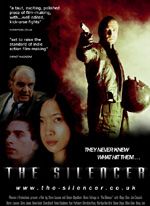
Glenn Salvage plays Michael Eastmann, a policeman who is framed during a botched drugs bust, shot and then left for dead (not to be mistaken by Left for Dead, another movie starring Salvage, where he isn't - left for dead that is). Horribly injured but not dead, he is rehabilitated and then sets out for vengeance. The only problem is he can no longer talk, and his spine is so badly damaged that a hard knock will paralyse him for life (OK, that's two problems). His wife (Choo) grows distant and his former colleagues shun him, but he can still kick arse.
Director Steve Lawson and star Glenn Salvage were both involved in Left for Dead, which was an overlong mess. The Silencer is the exact opposite, a short, neat action movie. The action scenes are great, including a great moment in an underpass where a bunch of thugs hassling a lady meet their worst, silent, motorcycle helmeted, leather clad nightmare. The story is pretty clichèd (although it flows well), but that's not the point, this is a movie about revenge, and it is served up with quality. This movie was made for virtually nothing (Lawson describes it as the cost of a family holiday). All indoor scenes were set in Lawson's house, where one room was continually remodelled for different scenes, and the cast was kept nice and small and mostly volunteered their services. And good for them too. Everyone looks good in this; Salvage has real presence and just a hint of charisma, the martial arts and stunts are awesome, and the directors show that they can really direct.
When they can make a $5,000 movie look like a $500,000 movie, imagine what they could do with $500,000. I am curious, and hopefully The Silencer will get the film-makers noticed by some people with some cash. So pay attention, all right!
$$$
Starring: Glenn Salvage, Maye Choo, Jim Clossick, Steve Lawson
Production Budget: ~US$5,000
Running Time: 75 min
Released: 2006
Glenn Salvage plays Michael Eastmann, a policeman who is framed during a botched drugs bust, shot and then left for dead (not to be mistaken by Left for Dead, another movie starring Salvage, where he isn't - left for dead that is). Horribly injured but not dead, he is rehabilitated and then sets out for vengeance. The only problem is he can no longer talk, and his spine is so badly damaged that a hard knock will paralyse him for life (OK, that's two problems). His wife (Choo) grows distant and his former colleagues shun him, but he can still kick arse.
Director Steve Lawson and star Glenn Salvage were both involved in Left for Dead, which was an overlong mess. The Silencer is the exact opposite, a short, neat action movie. The action scenes are great, including a great moment in an underpass where a bunch of thugs hassling a lady meet their worst, silent, motorcycle helmeted, leather clad nightmare. The story is pretty clichèd (although it flows well), but that's not the point, this is a movie about revenge, and it is served up with quality. This movie was made for virtually nothing (Lawson describes it as the cost of a family holiday). All indoor scenes were set in Lawson's house, where one room was continually remodelled for different scenes, and the cast was kept nice and small and mostly volunteered their services. And good for them too. Everyone looks good in this; Salvage has real presence and just a hint of charisma, the martial arts and stunts are awesome, and the directors show that they can really direct.
"The difference between pornography and erotica is lighting." - Gloria LeonardOne of the most obvious things that shows up a low budget movie is the lighting. The other martial arts movies I saw at Bloodbath, Left for Dead, and Intergalactic Combat were both notable for their bad lighting. The lighting in The Silencer is so much better, with light streeming through windows and a subtle glow on characters faces. Good lighting is one of those things that's difficult to describe, but obvious when you see it. This was $5,000 very well spent. If Left for Dead was martial arts porn, then this is martial arts erotica.
When they can make a $5,000 movie look like a $500,000 movie, imagine what they could do with $500,000. I am curious, and hopefully The Silencer will get the film-makers noticed by some people with some cash. So pay attention, all right!
$$$
Monday, January 08, 2007
Room 36
Director: Jim Groom
Starring: Paul Herzberg, Portia Booroff, Frank Scantori, Nicola Branson
Production Budget: ~US$300,000 (guesstimate)
Running Time: 90 min
Released: 2005
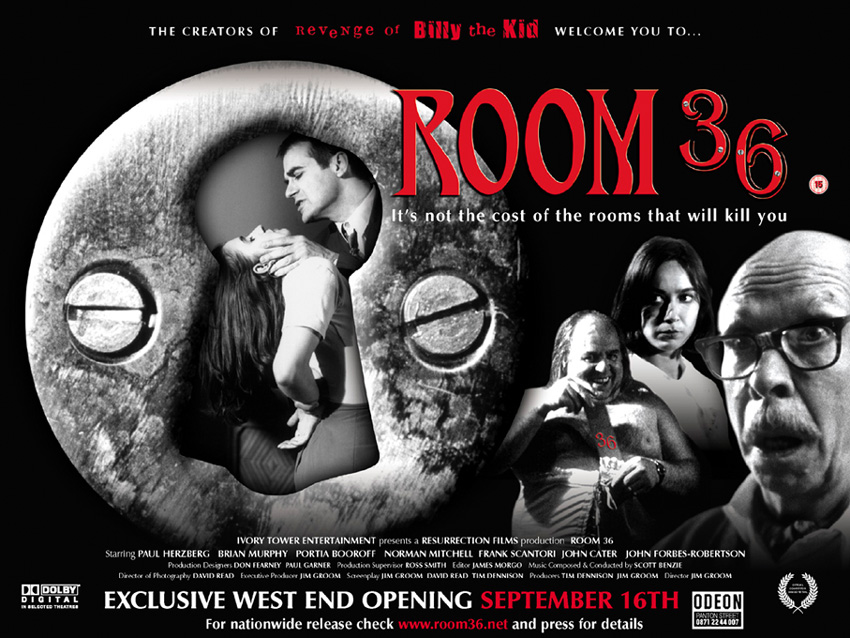
Set mostly in a seedy London hotel, the Midlothian, Room 36 is a tale of mistaken identity, although in this case it is the identity of the room that causes the confusion. In room 36, an obese salesman (Scantori) awaits a prostitute (Branson), while next door, in room 38 a hit-man (Herzberg) has arranged a meeting with a young, female MP (Booroff). All it takes is one chipped room number and things go horribly wrong.
Groom's only other movie was 1991s The Revenge of Billy the Kid which centred around the mutant child of a farmer and his goat (get it, Billy the Kid). I haven't seen it but am intrigued, and who wouldn't be?
I urge you to seek out this film, so then in another 11 years we might get to see what Groom comes up with next.
$$$$
Starring: Paul Herzberg, Portia Booroff, Frank Scantori, Nicola Branson
Production Budget: ~US$300,000 (guesstimate)
Running Time: 90 min
Released: 2005
Set mostly in a seedy London hotel, the Midlothian, Room 36 is a tale of mistaken identity, although in this case it is the identity of the room that causes the confusion. In room 36, an obese salesman (Scantori) awaits a prostitute (Branson), while next door, in room 38 a hit-man (Herzberg) has arranged a meeting with a young, female MP (Booroff). All it takes is one chipped room number and things go horribly wrong.
"It might be a Scottish name, taken from a story about two men in a train. One man says, 'What's that package up there in the baggage rack?' And the other answers, 'Oh that's a McGuffin.' The first one asks 'What's a McGuffin?' 'Well' the other man says, 'It's an apparatus for trapping lions in the Scottish Highlands.' The first man says, 'But there are no lions in the Scottish Highlands,' and the other one answers 'Well, then that's no McGuffin!' So you see, a McGuffin is nothing at all." - Alfred Hitchcock.This film took 11 years to make, due to one disaster after another, including death, fire and Kodak's decision to stop producing the film they were using half way through filming. Yet the director persisted, and it was well worth the effort. The grainy black and white looks fantastic, giving it very much the feel of a film noir or early Hitchcock. It even has a classic Hitchcockian McGuffin, in the microfilm the MP is supposed to be delivering to the man who turns out to be a hit-man. Yet it is also very funny, at times almost to the point of slapstick. The acting is excellent, not even considering the budget, and the 10 year commitment many of them made to it with little or no pay.
Groom's only other movie was 1991s The Revenge of Billy the Kid which centred around the mutant child of a farmer and his goat (get it, Billy the Kid). I haven't seen it but am intrigued, and who wouldn't be?
I urge you to seek out this film, so then in another 11 years we might get to see what Groom comes up with next.
$$$$
Saturday, December 30, 2006
Chain Reaction
Director: Olaf Ittenbach
Starring: Christopher Kriesa, Martina Ittenbach, Simon Newby
Production Budget: US$1.5M
Running Time: 103 min
Released: 2006
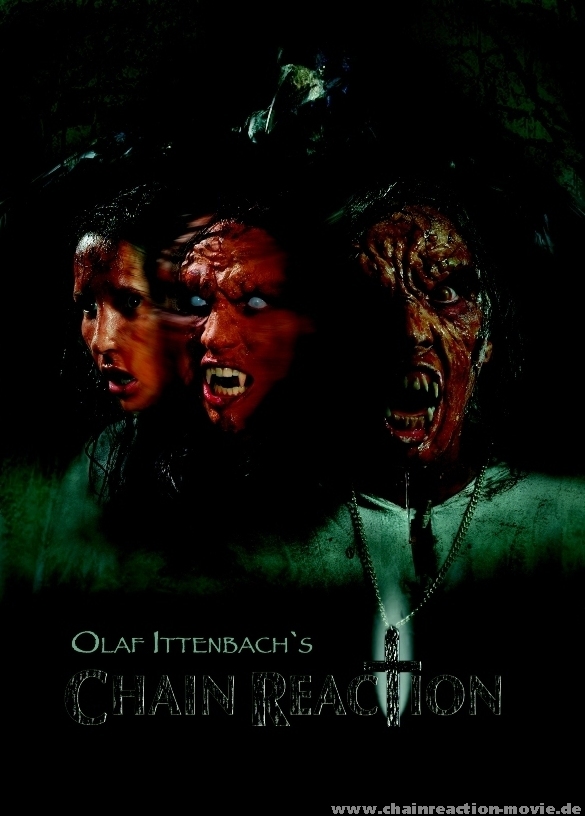
A dead Raven starts a freak chain of events leading to a prison transport bus crashing in the Rocky Mountains. The prisoners escape, kill the guards, take a doctor hostage and flee into the woods, heading for Canada. En route they stumble across an old homestead, and a young woman 'milking' (by which I mean bleeding) a goat. They break in and find a strange family, who speak nothing but dire old-English, resemble 18th century pilgrims and drink goat's blood. It turns out they are a family of vampires or demons or some-such and things soon turn messy, very messy.
This movie is really, incredibly stupid, and at times hilarious. Made by German director Olaf Ittenbach, it is pretty well directed, the acting is mostly OK - especially considering they are mostly Germans playing Americans - and the dialogue is mostly terrible. The residents of the house are supposed to be speaking old-English, perhaps like the Amish would speak, but it is basically incomprehensible. It's kind of a combination of bad Shakespeare and Yoda. Apart from "Aye, have I", which Martina Ittenbach's character constantly answers to every request, I don't have any particular quotes that I could give, as I didn't write them down at the time (and the internet has failed me, curse you!). But trust me, there are some piss-funny lines in there, as the chuckles throughout the cinema at supposedly serious conversation can attest.
Thou be able to enjoyest much bloodshed. Wherein thine prisoners findest a saw of chain, thou does not know, but byest then hast reason been given over to madness.
Sorry, what I mean is, there is plenty of blood, guts and decapitations. Where the hell the prisoners find a chainsaw in a primitive farm house I will never know, but by that point, reason has already taken a severe beating, and soon gets sawn in two (or possibly twain).
This is apparently one of the less gory of Ittenbach's movies, but since he is considered one of the goriest directors around, there is no shortage. He often works as a special effects supervisor on his own and other director's movies, and it shows. The make-up and effects are really good for such a low budget film - although I suspect IMDB (where I get most of my budget info) might be slightly underestimating the budget - if not, I'm impressed. The battle scenes are fairly short, but highly entertaining.
Oddly, this is like a movie and its sequel all in one. Once the first lot of action concludes, our good doctor is sentenced to prison, and while being transported on a prison bus a dead Raven starts a freak chain of events leading to a... never mind. I guess they just didn't have enough material for a full length movie. And the melodramatic ending is surreal and stupid.
Taken with two or three beers and a few mates, you should have a good time with Chain Reaction (called House of Blood if you are in the U.S.). Aye, didst I.
$$$
Starring: Christopher Kriesa, Martina Ittenbach, Simon Newby
Production Budget: US$1.5M
Running Time: 103 min
Released: 2006
A dead Raven starts a freak chain of events leading to a prison transport bus crashing in the Rocky Mountains. The prisoners escape, kill the guards, take a doctor hostage and flee into the woods, heading for Canada. En route they stumble across an old homestead, and a young woman 'milking' (by which I mean bleeding) a goat. They break in and find a strange family, who speak nothing but dire old-English, resemble 18th century pilgrims and drink goat's blood. It turns out they are a family of vampires or demons or some-such and things soon turn messy, very messy.
This movie is really, incredibly stupid, and at times hilarious. Made by German director Olaf Ittenbach, it is pretty well directed, the acting is mostly OK - especially considering they are mostly Germans playing Americans - and the dialogue is mostly terrible. The residents of the house are supposed to be speaking old-English, perhaps like the Amish would speak, but it is basically incomprehensible. It's kind of a combination of bad Shakespeare and Yoda. Apart from "Aye, have I", which Martina Ittenbach's character constantly answers to every request, I don't have any particular quotes that I could give, as I didn't write them down at the time (and the internet has failed me, curse you!). But trust me, there are some piss-funny lines in there, as the chuckles throughout the cinema at supposedly serious conversation can attest.
Thou be able to enjoyest much bloodshed. Wherein thine prisoners findest a saw of chain, thou does not know, but byest then hast reason been given over to madness.
Sorry, what I mean is, there is plenty of blood, guts and decapitations. Where the hell the prisoners find a chainsaw in a primitive farm house I will never know, but by that point, reason has already taken a severe beating, and soon gets sawn in two (or possibly twain).
This is apparently one of the less gory of Ittenbach's movies, but since he is considered one of the goriest directors around, there is no shortage. He often works as a special effects supervisor on his own and other director's movies, and it shows. The make-up and effects are really good for such a low budget film - although I suspect IMDB (where I get most of my budget info) might be slightly underestimating the budget - if not, I'm impressed. The battle scenes are fairly short, but highly entertaining.
Oddly, this is like a movie and its sequel all in one. Once the first lot of action concludes, our good doctor is sentenced to prison, and while being transported on a prison bus a dead Raven starts a freak chain of events leading to a... never mind. I guess they just didn't have enough material for a full length movie. And the melodramatic ending is surreal and stupid.
Taken with two or three beers and a few mates, you should have a good time with Chain Reaction (called House of Blood if you are in the U.S.). Aye, didst I.
$$$
Sunday, December 17, 2006
The Uncanny
Director: Denis Héroux
Starring: Peter Cushing, Ray Milland, Donald Pleasance
Production Budget: ~US$600,000
Running Time: 89 min
Released: 1977
As a life-long cat hater, The Uncanny didn't change my opinion of cats any, but I'd be interested to see what die-hard cat lovers think of it. Maybe if this movie inspires a few people not to own cats, then the birds, small mammals and allergy sufferers of the world will be thankful. So, as an allergy sufferer, I highly recommend this to all cat owners and would be owners. Everyone else, watch if it's on the telly, and there is nothing better on.
Starring: Peter Cushing, Ray Milland, Donald Pleasance
Production Budget: ~US$600,000
Running Time: 89 min
Released: 1977
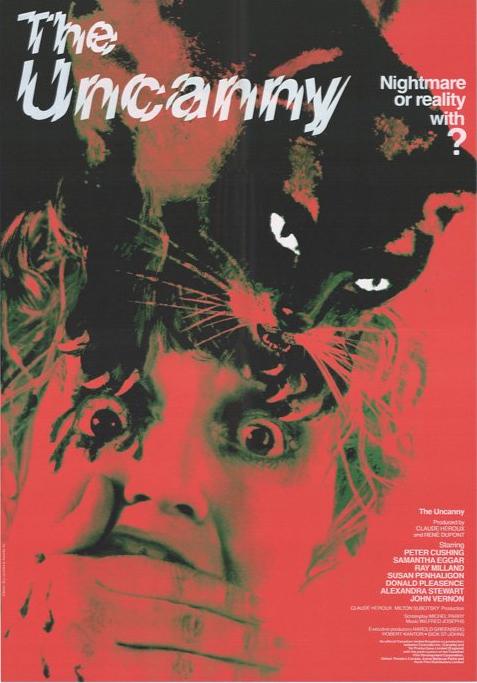
"Kitty at my foot and I want to touch it"Peter Cushing brings his unique comic stylings to this trilogy of tales about our fine feathered friends and secret rulers of the Earth, cats. It begins with him visiting a publisher and begging him to publish his book detailing the evils perpetuated by cats around the world. Being a pretty smart guy, he chooses a publisher who is a cat lover, duh. To prove his feline conspiracy theory, he relates a series of far-out feline tales (with plenty of far-out feline tails thrown in for good measure). The first involves an old rich woman who writes a will leaving most of her assets to her dozens of cats, and none to her no-good nephew. The nephew hatches a plan with the maid to kill the woman, destroy the will and take the fortune that is rightfully his (you know, rightfully his because his dad's sister is rich). The cats have other ideas, and things soon turn bloody and people get eaten (there are lots of cats in this one). The second sees a young girl unusual powers move in with her aunt and uncle when here parents die. Her bitchy cousin causes her grief until she and her beloved cat enact a squishy revenge. In the third episode, a famous actor (Pleasance) kills his actress wife in an "accident" and replaces her with a young, pretty, and untalented actress in both his current movie - coincidentally a filmed version of The Pit and the Pendulum - and his bed. But the dead wife's cat has other ideas.
"Kitty ran up and scratched me though my jeans"British horror studio Amicus was in decline when this movie was made - failing to get adequate funding in the UK, most of the financing and production came from Canada. The Uncanny follows an identical structure to previous Amicus anthologies such as Dr. Terror's House of Horrors (1964) and Tales from the Crypt (1972), which is a downside, as, by 1977 the traditional horror anthology had had it's day - although George A. Romero and Stephen King had fun with the concept in the 80's with the Creepshow movies - and this movie has the feel of a 1960s movie rather than a late 70s one, and probably looked dated when it was made. While mostly a bit silly - cats just aren't that scary - it is saved by some cool scenes, especially in the mass attacks and brutal killings in the first episode, and the surprising and bloody ending of the second.
As a life-long cat hater, The Uncanny didn't change my opinion of cats any, but I'd be interested to see what die-hard cat lovers think of it. Maybe if this movie inspires a few people not to own cats, then the birds, small mammals and allergy sufferers of the world will be thankful. So, as an allergy sufferer, I highly recommend this to all cat owners and would be owners. Everyone else, watch if it's on the telly, and there is nothing better on.
"Fuck you kitty, you're gonna spend the night... outside!" - The Presidents of the United States of America$$$
Friday, December 15, 2006
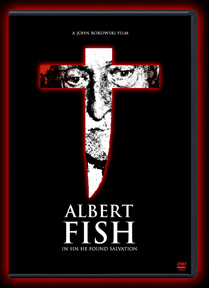
Albert Fish
Director: John Borowski
Starring: Oto Brezinn, Derek Hall, Cooney Horvath, Garrett Shriver
Production Budget: Dunno - pretty small
Running Time: 86 min
Released: 2007 - I traveled through time to see it.
This documentary is reminiscent of the types of American 'true crime story' or 'real life detective' shows you get on television. A deep-voiced narrator describes how a criminal was brought to justice, interspersed with recreations of the crimes and interviews with key figures and experts. The only thing that could really distinguish Albert Fish from the hundreds of these shows you get on the Discovery Channel is the criminal himself - Albert Fish, painter, gentleman and child-eater.
While Albert Fish was a deviant of the highest order, into such philias as coprophilia, urophilia and paedophilia, his most noteworthy act - and the subject of a fair chunk of the movie - was the letter he sent to the parents of Grace Budd, a ten year old girl he had abducted and, well, if you really want to know you can read the letter.
So, not overly original, but a well made documentary about an interesting topic, or, if you will, a decrepit piece of filth about a total sicko.
Starring: Oto Brezinn, Derek Hall, Cooney Horvath, Garrett Shriver
Production Budget: Dunno - pretty small
Running Time: 86 min
Released: 2007 - I traveled through time to see it.
This documentary is reminiscent of the types of American 'true crime story' or 'real life detective' shows you get on television. A deep-voiced narrator describes how a criminal was brought to justice, interspersed with recreations of the crimes and interviews with key figures and experts. The only thing that could really distinguish Albert Fish from the hundreds of these shows you get on the Discovery Channel is the criminal himself - Albert Fish, painter, gentleman and child-eater.
While Albert Fish was a deviant of the highest order, into such philias as coprophilia, urophilia and paedophilia, his most noteworthy act - and the subject of a fair chunk of the movie - was the letter he sent to the parents of Grace Budd, a ten year old girl he had abducted and, well, if you really want to know you can read the letter.
"On Sunday June the 3, 1928 I called on you at 406 W 15 St. Brought you pot cheese—strawberries. We had lunch. Grace sat in my lap and kissed me. I made up my mind to eat her." - Albert FishThe most interesting interviewee in this documentary is Joe Coleman, the man who owns the original Albert Fish letter, and is kind of a fan of Fish. Hilariously, he got the letter by going to the police records office and asking for a copy, and the clerk accidentally gave him the original, which he obviously kept. I'm thinking of doing the same with the Mona Lisa at the Louvre.
So, not overly original, but a well made documentary about an interesting topic, or, if you will, a decrepit piece of filth about a total sicko.
"Is that all you've got" - Allegedly said by Albert Fish after the first jolt of electricity failed to kill him. Also said by Marv in Sin City.$$$
Saturday, December 09, 2006
Intergalactic Combat
Director: Ray Brady 
Starring: Gordon Alexander, Elizabeth Tan
Production Budget: ~US$200,000
Running Time: 90 min
Released: 2006
By the same director as Boy Meets Girl but a very different movie, Intergalactic Combat is a movie that sounded great, but disappointed. It has an interesting, if rather juvenile premise. The Earth is invited to submit a team of warriors to an unarmed combat tournament against teams from other planets, with the losing planet destroyed, or something. However, not only do we not get see this intergalactic battle, we don't even get to see the world championships, just the selection trials for the UK team. Like the previously reviewed Dark Intruder, this is actually a T.V. pilot, although not funded by any T.V. station. The plan is for the first season of the series to feature the UK team travelling the world battling against other countries, with the second season concentrating on the interplanetary battle.
The CGI work is pretty basic and the dialogue is terrible, but after all, this is a dumb action film, and the action scenes are pretty well done. I'm not a huge fan of martial arts, unless it is being done by Jacky Chan, but Brady has obviously gotten a pretty decent bunch of fighters together, and the premise works to show off their skills. The characters are interesting enough (big black guy, former world champ coming out of retirement, oriental guy, young girl who learned to fight to get away from bully's, twin's; one good, one bad - that sort of thing) that kids could probably get into it. If made into a series, it would require a much bigger budget (Brady admitted as much at the screening), especially if they intend on having humans battling against CG aliens, which they do.
The main thing that bothered me about this movie was the following quote, taken from the IMDB summary, and featured in the Bloodbath programme.
$1/2

Starring: Gordon Alexander, Elizabeth Tan
Production Budget: ~US$200,000
Running Time: 90 min
Released: 2006
By the same director as Boy Meets Girl but a very different movie, Intergalactic Combat is a movie that sounded great, but disappointed. It has an interesting, if rather juvenile premise. The Earth is invited to submit a team of warriors to an unarmed combat tournament against teams from other planets, with the losing planet destroyed, or something. However, not only do we not get see this intergalactic battle, we don't even get to see the world championships, just the selection trials for the UK team. Like the previously reviewed Dark Intruder, this is actually a T.V. pilot, although not funded by any T.V. station. The plan is for the first season of the series to feature the UK team travelling the world battling against other countries, with the second season concentrating on the interplanetary battle.
The CGI work is pretty basic and the dialogue is terrible, but after all, this is a dumb action film, and the action scenes are pretty well done. I'm not a huge fan of martial arts, unless it is being done by Jacky Chan, but Brady has obviously gotten a pretty decent bunch of fighters together, and the premise works to show off their skills. The characters are interesting enough (big black guy, former world champ coming out of retirement, oriental guy, young girl who learned to fight to get away from bully's, twin's; one good, one bad - that sort of thing) that kids could probably get into it. If made into a series, it would require a much bigger budget (Brady admitted as much at the screening), especially if they intend on having humans battling against CG aliens, which they do.
The main thing that bothered me about this movie was the following quote, taken from the IMDB summary, and featured in the Bloodbath programme.
"An action movie shot in real time that plays out like a shoot-em-up video game. Stunning camera work, complex and always moving. An un-relentless action film that will attract, through word of mouth, all those hooked on gaming on their PC's and drag them back into the cinema auditoriums." - bRAdYI suppose there is nothing wrong with the director writing his own plot summary, and talking up his "stunning camera work", and the "un-relentless action", however, the phrase "plays out like a shoot-em-up video game" is just plain misleading. As any geek knows, shoot 'em up video games involve a single character or - more commonly - spaceship moving through various levels shooting things up. Intergalactic Combat's real time element involves cutting from character to character as they have battles with a variety of adversaries in different set locations. This is somewhat reminiscent of versus fighting games like Street Fighter II, but certainly bears no resemblance to any shoot 'em up. You need to get your terminology right, Ray! People (like me and the Comic Book Guy) are very particular about this kind of thing. I can assure you, no-one ever recovers from a "Worst. Episode. Ever" put-down, so don't risk it.
"There is no emoticon for what I am feeling!"As a low-budget pilot for a children's television show in the vain of Mighty Morphin Power Rangers, this works. As something I would ever want to see again in a million years, it doesn't.
$1/2
Thursday, December 07, 2006
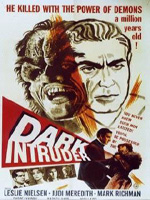
Dark Intruder
Director: Harvey Hart
Starring: Leslie Nielson, Peter Mark Richman, Judi Meredith, Gilbert Green
Production Budget: Small
Running Time: 59 min
Released: 1965
This was originally filmed as a T.V. pilot for a series called Black Cloak. The series was never made, so they released it as a film in an attempt to recoup costs. It is not immediately obvious that this is a T.V. show, but the structure and especially the ending imply something that will be ongoing.
Leslie Nielson plays Brett Kingsford, a playboy in San Francisco in the late 19th century who secretly aids the police in investigations of the occult. The story concerns a series of brutal murders, apparently committed by someone/thing not entirely human. After each murder a strange statuette appears, which slowly mutates, providing the key clue. Assisting the police in matters of the occult does not sit well within Kingsford's peer group, so he takes to wearing disguises when out with the police - although, why he would need a different costume for each meeting belies explanation. Kingsford's eccentricity is established early on, as we are introduced to him, his dwarf butler and has large old house full of secret passages.
It's unlikely that many people will get a chance to see this. After five minutes searching the Internet, I couldn't find any information about DVD availability. I guess it's the philosophical question of our time... if it's not available online, does it actually exist.
$$$
Starring: Leslie Nielson, Peter Mark Richman, Judi Meredith, Gilbert Green
Production Budget: Small
Running Time: 59 min
Released: 1965
This was originally filmed as a T.V. pilot for a series called Black Cloak. The series was never made, so they released it as a film in an attempt to recoup costs. It is not immediately obvious that this is a T.V. show, but the structure and especially the ending imply something that will be ongoing.
Leslie Nielson plays Brett Kingsford, a playboy in San Francisco in the late 19th century who secretly aids the police in investigations of the occult. The story concerns a series of brutal murders, apparently committed by someone/thing not entirely human. After each murder a strange statuette appears, which slowly mutates, providing the key clue. Assisting the police in matters of the occult does not sit well within Kingsford's peer group, so he takes to wearing disguises when out with the police - although, why he would need a different costume for each meeting belies explanation. Kingsford's eccentricity is established early on, as we are introduced to him, his dwarf butler and has large old house full of secret passages.
"Surely you cant' be serious."This movie was made well before Airplane (a.k.a. Flying High), after which Nielson became typecast (and made millions of dollars) as the deadpan we all knew and loved, and then got sick of - anyone keen on Scary Movie V? It's in production. In this he plays the playboy (or should that just be 'plays the boy') with a knowing glint in his eye. The character is quite similar to Bruce Wayne, in that he is superficially a self-centred nob, but secretly has a deadly serious vocation, which his wealth allows him to pursue.
"I am serious, and don't call me Shirley"
It's unlikely that many people will get a chance to see this. After five minutes searching the Internet, I couldn't find any information about DVD availability. I guess it's the philosophical question of our time... if it's not available online, does it actually exist.
"Surely there must be something you can do."Maybe it will come on the telly late one night. If so, it's worth a look. It's entertaining enough and you may see Nielson as you have never seen him before - although if you feel that way inclined, Forbidden Planet is a really good early Nielson film.
"I'm doing everything I can... and stop calling me Shirley."
$$$
Monday, December 04, 2006
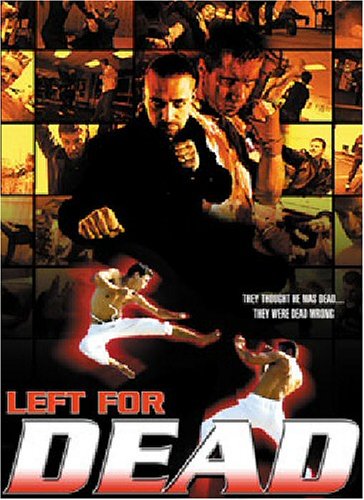
Left for Dead
Director: Ross Boyask
Starring: Glenn Salvage, Andy Prior, Adam Chapman
Production Budget: Small, self funded.
Running Time: 105 min
Released: 2004
I enjoyed this movie for the first 20 min, up until the time the DVD screening at Bloodbath crashed. It featured a long and inventive battle scene set outdoors in an industrial area in a fictional UK city; loads of Kung Fu, an assortment of weapons, and splatterings of blood. Once the projectionist sorted out the problems and the rest of the movie screened, I was in for a disappointment. The next 80 minutes feature about 5 minutes of unoriginal storyline (mobster thug decides to retire, boss won't let him, sends other thugs to kill him, they fail, and thug sets about enacting revenge) and the rest wall-to-wall martial arts fighting.
This movie is basically a porn movie with martial arts replacing sex. It has bad lighting, bad acting, but will work for those looking for some cheap thrills, in the form of people beating the crap out of each other.
$$
Starring: Glenn Salvage, Andy Prior, Adam Chapman
Production Budget: Small, self funded.
Running Time: 105 min
Released: 2004
I enjoyed this movie for the first 20 min, up until the time the DVD screening at Bloodbath crashed. It featured a long and inventive battle scene set outdoors in an industrial area in a fictional UK city; loads of Kung Fu, an assortment of weapons, and splatterings of blood. Once the projectionist sorted out the problems and the rest of the movie screened, I was in for a disappointment. The next 80 minutes feature about 5 minutes of unoriginal storyline (mobster thug decides to retire, boss won't let him, sends other thugs to kill him, they fail, and thug sets about enacting revenge) and the rest wall-to-wall martial arts fighting.
"It becomes quickly apparent that the film's main remit is to screen as many fight sequences as humanly possible, but one can have too much of a good thing and ultimately sometimes less is more" - Bloodbath programme notes.This may work as a CV padding exercise for the director and performers to show off as many of their skills as possible, but as a movie, I found it pretty boring. Practically the whole thing was just people fighting. While the fight scenes are well choreographed, the overall production values are uninspiring. The Silencer, which was shown the following night, features the same lead (Salvage), and many of the same performers and elements as Left for Dead, and is so much better, thanks to a better story, better production and better direction - my review of this should be up in the next week or so.
This movie is basically a porn movie with martial arts replacing sex. It has bad lighting, bad acting, but will work for those looking for some cheap thrills, in the form of people beating the crap out of each other.
$$
Sunday, December 03, 2006
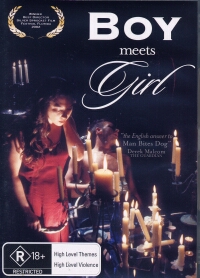
Boy Meets Girl
Director: Ray Brady
Starring: Tim Poole, Danielle Sanderson, Margo Steinberg
Production Budget: under US$100,000
Running Time: 93 min
Boy meets girl, girl drugs boy, girl tortures boy - repeatedly, for 80 minutes. That's about it.
Boy Meets Girl is remarkably similar to 2006's Hard Candy. In fact, in many ways they are almost identical. A man is drugged, then tied up, and a battle of wills ensues with his captor. The main difference is the motivation of the female character. In Hard Candy, the girl is motivated by revenge against paedophiles, while in Boy Meets Girl, the motivation is pretty much non-existent. She's just a cruel, cruel person.
Oddly, about 20 minutes in, the female character (Steinberg) is rather inexplicably replaced with a completely different woman (Sanderson). It turns out that part way through filming, Brady decided that Steinberg wasn't working out, and replaced her, and rather than re-film the start, he worked this into the script. It's a bit awkward, but understandable given that he was just starting film school and had a very limited budget to work with.
This is an ultra low budget, psychological thriller, with convincing performances. It's uncomfortable to watch, but you will enjoy this if you take pleasure in watching other people take pleasure in the pain of others (which I guess would make you a metasadist). That doesn't make you a bad person, mind.
$$$
*Marquis de Sade, sadism, spades, get it?
Starring: Tim Poole, Danielle Sanderson, Margo Steinberg
Production Budget: under US$100,000
Running Time: 93 min
Boy meets girl, girl drugs boy, girl tortures boy - repeatedly, for 80 minutes. That's about it.
"Sadism: a sexual perversion in which gratification is obtained by the infliction of physical or mental pain on others" - Merrian Webster Online.This was banned for 8 years in Britain, yet has no sex, no nudity, and very little blood. Ray Brady has admitted that he set out to make a censor baiting film. He researched the main reasons movies had been banned in the previous few years, then added those elements together to create this movie. It seems the censors weren't especially worried by the obvious things above, it was sustained sadism that got them hot under the collar, and Boy Meets Girl has this in spades (or, in rhyming slang, Marquis de Sades*). Sadism, depravity, torture, microwaved hands... it's all there. When the main character is tied to a dentists chair in his underwear for 9/10ths of the movie, you can be sure this is not going to be a romantic comedy.
Boy Meets Girl is remarkably similar to 2006's Hard Candy. In fact, in many ways they are almost identical. A man is drugged, then tied up, and a battle of wills ensues with his captor. The main difference is the motivation of the female character. In Hard Candy, the girl is motivated by revenge against paedophiles, while in Boy Meets Girl, the motivation is pretty much non-existent. She's just a cruel, cruel person.
Oddly, about 20 minutes in, the female character (Steinberg) is rather inexplicably replaced with a completely different woman (Sanderson). It turns out that part way through filming, Brady decided that Steinberg wasn't working out, and replaced her, and rather than re-film the start, he worked this into the script. It's a bit awkward, but understandable given that he was just starting film school and had a very limited budget to work with.
This is an ultra low budget, psychological thriller, with convincing performances. It's uncomfortable to watch, but you will enjoy this if you take pleasure in watching other people take pleasure in the pain of others (which I guess would make you a metasadist). That doesn't make you a bad person, mind.
$$$
*Marquis de Sade, sadism, spades, get it?
Saturday, December 02, 2006
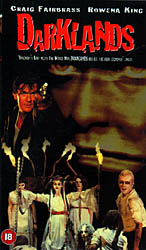
Darklands
Director: Julian Richards
Starring: Craig Fairbrass, Jon Finch, Rowena King, Roger Nott
Production Budget: US$750,000
Running Time: 90 min
This movie will probably never be mentioned without being linked with The Wicker Man, which is a shame. It's not that the films aren't similar, (they are) it's more that mentioning the similarities between Darklands and such an iconic film a) belittles this film, and b) ruins the ending which would otherwise come as a shock. It is perhaps because of this that whereas the ending of The Wicker Man is rather drawn out, the ending here is quick and brutal - perhaps Richards realised that the ending would be widely known beforehand, so there was no point dwelling.
Julian Richards admitted before the screening that he didn't know everything about film-making when he made Darklands, which was released in 1996, and for the DVD release he has re-edited the film, removing 7 min that were either awkward (including taking out a sex scene: who has ever done that voluntarily?) or slowed the first act. This 'director's cut' was what we saw at Bloodbath, and while I have not seen the original for comparison, I was pretty satisfied with this version. After the film, Richards complained that he was forced to use Craig Fairbrass in the main role due to a pre-existing contract Fairbrass had with the financiers. He felt that Fairbrass was not suited to the role, but, even so, I thought he was quite good, and certainly the biggest presence in the movie. The other performances are also pretty good.
While others would complain that Darklands is derivative, there are some original elements which I really liked. One particular scene which I found particularly cool (although it may be just me) was when Truik is filling his car up at a petrol station, when the police arrive. He asks the attendant where the toilets are (cliché), then climbs out the window of the toilet (cliché) and flees through the backyard where he has to scale a barbed wire fence. All clichés up to this point. But then, instead of barely escaping with torn clothing as you'd expect, he gets stuck on the fence, rips his leg open, and gets arrested and taken to hospital. Like I said, cool.
I believe this is the best Welsh horror film I have ever seen.
$$$1/2
Starring: Craig Fairbrass, Jon Finch, Rowena King, Roger Nott
Production Budget: US$750,000
Running Time: 90 min
The fact that the writer/director had to write his own plot summary on IMDB sums up the lack of interest in this movie. Just to rub it in, there are no trivia and no goof listings.Darklands follows journalist Frazer Truick as he investigates the mysterious death of the brother of trainee journalist Rachel Morris. Delving deeper, Truick becomes convinced that the tragedy was murder, committed by a bizarre religious cult. But as the evidence unfolds, things take on a more sinister and potentially lethal significance for the reporter, as he becomes embroiled in devil worship, witchcraft and ultimately human sacrifice!
Summary written by Julian Richards
"Darklands, a 1996 Welsh horror film." - The complete text of the Wikipedia listing.
This movie will probably never be mentioned without being linked with The Wicker Man, which is a shame. It's not that the films aren't similar, (they are) it's more that mentioning the similarities between Darklands and such an iconic film a) belittles this film, and b) ruins the ending which would otherwise come as a shock. It is perhaps because of this that whereas the ending of The Wicker Man is rather drawn out, the ending here is quick and brutal - perhaps Richards realised that the ending would be widely known beforehand, so there was no point dwelling.
Julian Richards admitted before the screening that he didn't know everything about film-making when he made Darklands, which was released in 1996, and for the DVD release he has re-edited the film, removing 7 min that were either awkward (including taking out a sex scene: who has ever done that voluntarily?) or slowed the first act. This 'director's cut' was what we saw at Bloodbath, and while I have not seen the original for comparison, I was pretty satisfied with this version. After the film, Richards complained that he was forced to use Craig Fairbrass in the main role due to a pre-existing contract Fairbrass had with the financiers. He felt that Fairbrass was not suited to the role, but, even so, I thought he was quite good, and certainly the biggest presence in the movie. The other performances are also pretty good.
While others would complain that Darklands is derivative, there are some original elements which I really liked. One particular scene which I found particularly cool (although it may be just me) was when Truik is filling his car up at a petrol station, when the police arrive. He asks the attendant where the toilets are (cliché), then climbs out the window of the toilet (cliché) and flees through the backyard where he has to scale a barbed wire fence. All clichés up to this point. But then, instead of barely escaping with torn clothing as you'd expect, he gets stuck on the fence, rips his leg open, and gets arrested and taken to hospital. Like I said, cool.
I believe this is the best Welsh horror film I have ever seen.
$$$1/2
Friday, December 01, 2006
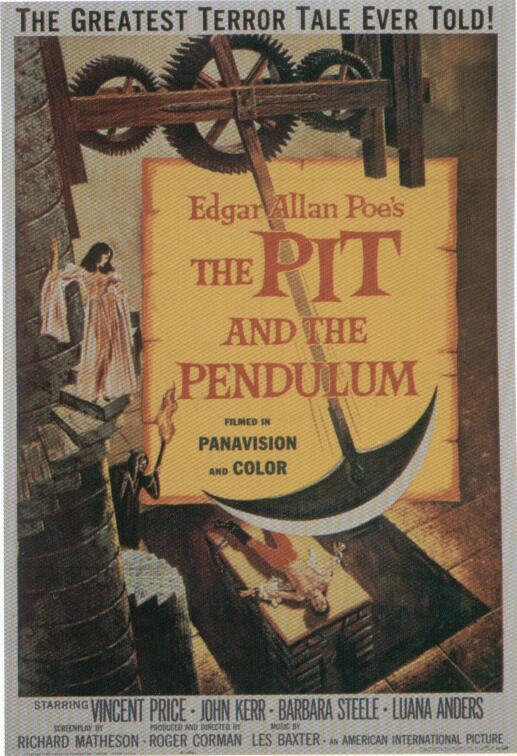
Pit and the Pendulum
Director: Roger Corman
Starring: Vincent Price, John Kerr, Barbara Steele, Luana Anders, Antony Carbone
Production Budget: US$200,000 (1961 dollars)
Running Time: 80 min
Roger Corman directed a number of Edgar Alan Poe adaptations in the early '60s, and this was the second - and the second to feature Vincent Price - after House of Usher (1960). Price plays neither the Pit nor the Pendulum, instead taking on the role of Don Nicholas Medina, 16th century Spanish (or possibly Italian, I never quite worked it out) lord and grieving husband. The movie starts with the rather clichéd man rides in carriage to castle, but local carriage driver refuses to get close to the castle so man has to walk the rest of the way scene (also seen in the recently reviewed and much older Nosferatu). The man in question is Francis Barnard (Kerr), Englishman and brother to the recently deceased wife of Nicholas. He insists on finding out the truth about the death of his sister Elizabeth (Steele), while spending some quality time with Nicholas' sister, the lovely Catherine (Anders). Nicholas initially insists that Elizabeth was killed by a blood disease, but things turn a little murky when a local doctor (Carbone) and friend to the Medina's comes to visit, and they admit that she was killed from fright. Or was she? Events begin to get a little darker when we discover that Nicholas' father was in the Spanish Inquisition, and used to hold his 'inquiries' in the dungeon of the castle, and nobody ever bothered to remove the tools of that particular trade.
The mystery evolves throughout the movie, with plenty of twists and surprises along the way, all leading to an excellent shock ending. The castle setting is beautifully realised, especially the dungeon. The performances are fantastic, with Price giving a very subtle performance for most of the film, as the distressed and confused husband, although you get a few glimpses of the wacky and crazy act he was so famous for. Everything works; the scares are scary, the twists are unexpected but 'obvious when you think about it' (the perfect kind of twist, in my opinion) and the tension builds nicely throughout. A class act.
$$$$
P.S. I still would like to see Uwe Boll direct an adaptation of Pitfall!, but I guess I'll have to wait until he is done butchering Dungeon Siege.
Starring: Vincent Price, John Kerr, Barbara Steele, Luana Anders, Antony Carbone
Production Budget: US$200,000 (1961 dollars)
Running Time: 80 min
Roger Corman directed a number of Edgar Alan Poe adaptations in the early '60s, and this was the second - and the second to feature Vincent Price - after House of Usher (1960). Price plays neither the Pit nor the Pendulum, instead taking on the role of Don Nicholas Medina, 16th century Spanish (or possibly Italian, I never quite worked it out) lord and grieving husband. The movie starts with the rather clichéd man rides in carriage to castle, but local carriage driver refuses to get close to the castle so man has to walk the rest of the way scene (also seen in the recently reviewed and much older Nosferatu). The man in question is Francis Barnard (Kerr), Englishman and brother to the recently deceased wife of Nicholas. He insists on finding out the truth about the death of his sister Elizabeth (Steele), while spending some quality time with Nicholas' sister, the lovely Catherine (Anders). Nicholas initially insists that Elizabeth was killed by a blood disease, but things turn a little murky when a local doctor (Carbone) and friend to the Medina's comes to visit, and they admit that she was killed from fright. Or was she? Events begin to get a little darker when we discover that Nicholas' father was in the Spanish Inquisition, and used to hold his 'inquiries' in the dungeon of the castle, and nobody ever bothered to remove the tools of that particular trade.
The mystery evolves throughout the movie, with plenty of twists and surprises along the way, all leading to an excellent shock ending. The castle setting is beautifully realised, especially the dungeon. The performances are fantastic, with Price giving a very subtle performance for most of the film, as the distressed and confused husband, although you get a few glimpses of the wacky and crazy act he was so famous for. Everything works; the scares are scary, the twists are unexpected but 'obvious when you think about it' (the perfect kind of twist, in my opinion) and the tension builds nicely throughout. A class act.
"No one will ever enter this room again" - Catherine MedinaIt is worth seeing this movie for that line alone.
$$$$
P.S. I still would like to see Uwe Boll direct an adaptation of Pitfall!, but I guess I'll have to wait until he is done butchering Dungeon Siege.
Thursday, November 30, 2006
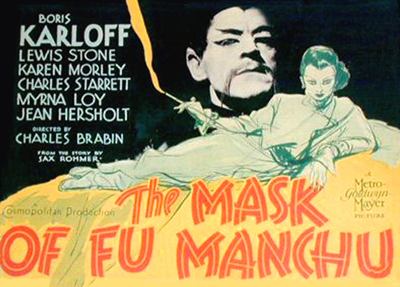
The Mask of Fu Manchu
Director: Charles Brabin
Starring: Boris Karloff, Myrna Loy, Lewis Stone, Lawrence Grant
Production Budget: US$327,627 (although it was 1932)
Running Time: 68 min
There have been at least ten Fu Manchu movies, based on the novels of Sax Rohmer, and this is considered the best. I don't really have much good or bad to say about this movie, it was just OK. There are some pretty cool special effects for 1932, such as Fu Manchu manipulating static electricity with his bare hands. Karloff has some charisma, and the other leads are perfectly fine in their respective roles. I may not, however, be judging this movie completely fairly. It was late, and I rested my eyes a couple of times before the end.
If you are a Boris Karloff fan you'll want to see his performance, or you could check out the film as an historical curiosity. Otherwise, stick to Flash Gordon and Ming the Merciless - pretty much the same character but less racist, more planetist, and with a kick-arse soundtrack.
$$1/2
Starring: Boris Karloff, Myrna Loy, Lewis Stone, Lawrence Grant
Production Budget: US$327,627 (although it was 1932)
Running Time: 68 min
"Will we ever understand these Eastern races?" - Nayland Smith (Lewis Stone)Boris Karloff plays Dr. Fu Manchu, Chinese intellectual and wannabe ruler of the world. It took him 2.5 hours each day to apply his make-up, which is a valiant sacrifice considering, well, they could have got a Chinese guy to play the part, who could have spent five minutes combing his moustache and looked more convincing. Likewise, his daughter, Fa Loh See is played by all American girl Myrna Loy. Cultural insensitivity aside, this is a thriller; Archeaologist Nayland Smith is kidnapped by the evil Dr. (as opposed to the Dr. Evil), who tries to wring out of him the location of the tomb of Ghengis Khan, the contents of which will allow Manchu to create an Asian superpower which will enslave the world. Lionel Barton (Grant) travels to Mongolia to find Khan's tomb before Manchu does. Once found, Smith attempts to smuggle the relics - a mask and sword - out of the country. Things don't go exactly to plan; people get tortured, drugged, zapped, donged and fed to crocodiles. I guess Dr. Fu Manchu is the original Dr. Evil.
There have been at least ten Fu Manchu movies, based on the novels of Sax Rohmer, and this is considered the best. I don't really have much good or bad to say about this movie, it was just OK. There are some pretty cool special effects for 1932, such as Fu Manchu manipulating static electricity with his bare hands. Karloff has some charisma, and the other leads are perfectly fine in their respective roles. I may not, however, be judging this movie completely fairly. It was late, and I rested my eyes a couple of times before the end.
If you are a Boris Karloff fan you'll want to see his performance, or you could check out the film as an historical curiosity. Otherwise, stick to Flash Gordon and Ming the Merciless - pretty much the same character but less racist, more planetist, and with a kick-arse soundtrack.
$$1/2
Wednesday, November 29, 2006
The Call of Cthulhu
Director: Andrew Leman
Starring: Matt Foyer, John Bolen, Ralph Lucas
Production Budget: Unknown (v. small)
Running Time: 47 min
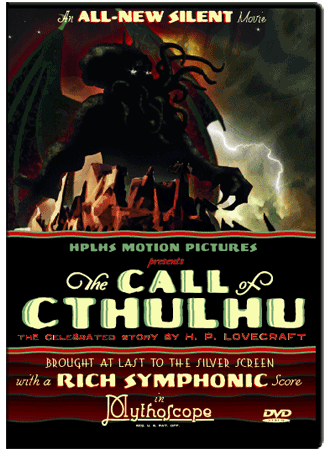
A man inherits the notebooks of his great-uncle, in which are detailed an investigation into a strange cult. He becomes obsessed with continuing the investigation, and travels the world searching for clues, becoming more and more frantic as he gets closer to the horrible truth - that there is a big squid demon living on an island in the pacific (kind of a spoiler, I know, but it is on the poster).
H.P. Lovecraft published The Call of Cthulhu in 1928, and while this movie was released in 2005, it is made to look as if it were made at the time the story was published. Produced by the H.P. Lovecraft Historical Society, this is a fascinating example of budget film-making, and an amazingly well made movie.
The movie was produced in what the makers call 'Mythoscope' - combining modern equipment with old techniques to make the movie appear as though it was filmed in the 1920s. There is no dialogue or sound other than music, and the special effects involve miniature sets, stop motion animation and water imitated by waving sheets. There is no CGI but some green-screen. The attention to detail is such that they even rough up the footage and add silent film flickering in post-production. The music is likewise altered to appear older. While it is unlikely to fool anyone into thinking it was actually made in the '20s - it's still a little new looking - I adore what they have done with it. Rather than attempting to make a low budget film look like a big budget film (like some of the other movies in the festival, which fail rather miserably), they have used the low budget to their advantage - they are not afraid to make things that look a bit fake in order to capture the silent-movie look and feel. They have also avoided the often dangerous task of modernising the story for a contemporary audience (although someone else is doing precisely that, with Tori Spelling, no less), and have instead embraced the anachronisms, and remained very faithful to the story (er, at least I assume so, having obviously not read it - see my preview).
The music is amazing. It is a big symphonic score, precisely matching the on-screen action, and it just blew me away. It's rare that music in a movie has such a big effect on me, but I guess that given that the movie is otherwise silent, the music is more in-your-face than usual. There are some moments that are quite scary, especially a scene involving a police raid on a cult gathering in a swamp. While the imagery is quite disturbing at this point, I can also imagine closing my eyes and being equally frightened by the haunting tunes. Actually I'd probably be more frightened as I wouldn't be able to see what was happening and my imagination would go crazy from the aural bombardment.
Apparently some people genuinely believe in and worship Cthulhu, but then people like blood sausage too. People are morons.
$$$$1/2
Starring: Matt Foyer, John Bolen, Ralph Lucas
Production Budget: Unknown (v. small)
Running Time: 47 min
A man inherits the notebooks of his great-uncle, in which are detailed an investigation into a strange cult. He becomes obsessed with continuing the investigation, and travels the world searching for clues, becoming more and more frantic as he gets closer to the horrible truth - that there is a big squid demon living on an island in the pacific (kind of a spoiler, I know, but it is on the poster).
H.P. Lovecraft published The Call of Cthulhu in 1928, and while this movie was released in 2005, it is made to look as if it were made at the time the story was published. Produced by the H.P. Lovecraft Historical Society, this is a fascinating example of budget film-making, and an amazingly well made movie.
The movie was produced in what the makers call 'Mythoscope' - combining modern equipment with old techniques to make the movie appear as though it was filmed in the 1920s. There is no dialogue or sound other than music, and the special effects involve miniature sets, stop motion animation and water imitated by waving sheets. There is no CGI but some green-screen. The attention to detail is such that they even rough up the footage and add silent film flickering in post-production. The music is likewise altered to appear older. While it is unlikely to fool anyone into thinking it was actually made in the '20s - it's still a little new looking - I adore what they have done with it. Rather than attempting to make a low budget film look like a big budget film (like some of the other movies in the festival, which fail rather miserably), they have used the low budget to their advantage - they are not afraid to make things that look a bit fake in order to capture the silent-movie look and feel. They have also avoided the often dangerous task of modernising the story for a contemporary audience (although someone else is doing precisely that, with Tori Spelling, no less), and have instead embraced the anachronisms, and remained very faithful to the story (er, at least I assume so, having obviously not read it - see my preview).
The music is amazing. It is a big symphonic score, precisely matching the on-screen action, and it just blew me away. It's rare that music in a movie has such a big effect on me, but I guess that given that the movie is otherwise silent, the music is more in-your-face than usual. There are some moments that are quite scary, especially a scene involving a police raid on a cult gathering in a swamp. While the imagery is quite disturbing at this point, I can also imagine closing my eyes and being equally frightened by the haunting tunes. Actually I'd probably be more frightened as I wouldn't be able to see what was happening and my imagination would go crazy from the aural bombardment.
Mental Note: keep eyes openIf you are a fan of gothic horror, silent film, or the beauty of low-budget film making, seek this movie out. If you can see it on the big screen, great, otherwise get the DVD and turn it up LOUD.
Apparently some people genuinely believe in and worship Cthulhu, but then people like blood sausage too. People are morons.
$$$$1/2
Tuesday, November 28, 2006
The Witches Hammer
Director: James Eaves
Starring: Claudia Coulter, Johnathan Sidgwick, Stephanie Beacham
Production Budget: Unknown (small)
Running Time: 93 min
A young woman is killed, then genetically modified into a vampire by government scientists and forced to work in their vampire slaying department. When her agency is destroyed by vampires and witches, she hooks up with a different set of witches to find an ancient tome called Malleus Maleficarum or, in English, The Witches' Hammer (what do you know, I was right about the bad grammar in the title) before the bad guys get it. This main story is interspersed with the back-stories of a number of the supplementary characters, and the story of the book itself.
A fanboys wet dream, this movie has it all: vampires, witches, demons, ninjas and circus freaks. The producers are obviously big fans of Buffy, Highlander and Blade.
There isn't much new here. It very much resembles an early episode of Buffy, with special effects to match. Coulter is effective in the main role, being tall, athletic and sexy, and Stephanie Beacham adds some class as the head witch. There are a few inventive set pieces, and a clever torture scene involving a vampire and a sun-bed, and the back-stories look nice.
A few things don't make sense, like at the beginning of the film I am sure she was attacked by a vampire. Why then, was it necessary to genetically modify her into a vampire? Anybody? Also, while it is admirable to incorporate historical facts into the movie, it's a little odd that the Witches' Hammer is this movie is a handbook for witches, when the actual Malleus Maleficarum was a witch-hunters handbook. This is the kind of thing the Buffy crowd are going to pick up on. I feel sorry for the director and actors if they ever find themselves at a science fiction convention.
$$1/2
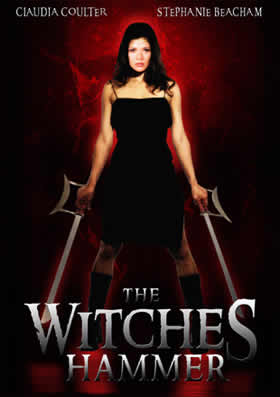
Starring: Claudia Coulter, Johnathan Sidgwick, Stephanie Beacham
Production Budget: Unknown (small)
Running Time: 93 min
A young woman is killed, then genetically modified into a vampire by government scientists and forced to work in their vampire slaying department. When her agency is destroyed by vampires and witches, she hooks up with a different set of witches to find an ancient tome called Malleus Maleficarum or, in English, The Witches' Hammer (what do you know, I was right about the bad grammar in the title) before the bad guys get it. This main story is interspersed with the back-stories of a number of the supplementary characters, and the story of the book itself.
A fanboys wet dream, this movie has it all: vampires, witches, demons, ninjas and circus freaks. The producers are obviously big fans of Buffy, Highlander and Blade.
There isn't much new here. It very much resembles an early episode of Buffy, with special effects to match. Coulter is effective in the main role, being tall, athletic and sexy, and Stephanie Beacham adds some class as the head witch. There are a few inventive set pieces, and a clever torture scene involving a vampire and a sun-bed, and the back-stories look nice.
A few things don't make sense, like at the beginning of the film I am sure she was attacked by a vampire. Why then, was it necessary to genetically modify her into a vampire? Anybody? Also, while it is admirable to incorporate historical facts into the movie, it's a little odd that the Witches' Hammer is this movie is a handbook for witches, when the actual Malleus Maleficarum was a witch-hunters handbook. This is the kind of thing the Buffy crowd are going to pick up on. I feel sorry for the director and actors if they ever find themselves at a science fiction convention.
Least. Historically. Accurate. Movie. Ever.Not a bad effort, but the concept is perhaps a bit ambitious, and the small budget does hurt (did I just say that?). It lacks the wit of Buffy, but people who are into that kind of thing will find plenty to like here.
$$1/2
Subscribe to:
Posts (Atom)
